
How to Keep a School Lunch Cold Until Lunchtime
Use an insulated bag and two cold sources, not one. How long a packed lunch is actually safe, what to pack with no fridge, and how to get it eaten.
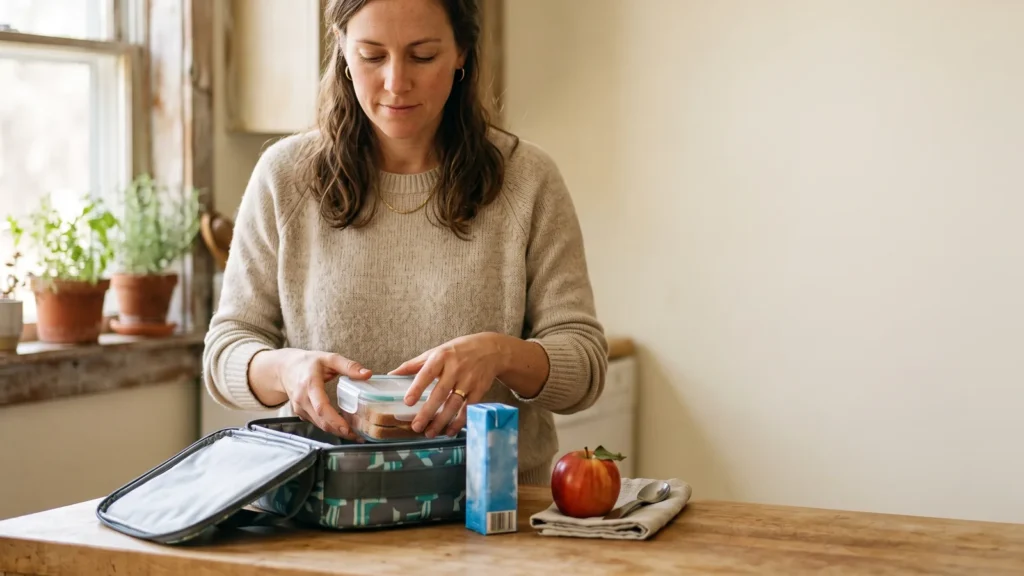
Use an insulated lunch bag and pack two cold sources, not one. Two frozen gel packs, or one gel pack plus a frozen juice box or frozen water bottle. That is what keeps a packed lunch below 40°F until noon.
The reason this matters more than it sounds: a lunch packed at 7am and eaten at 12 has been sitting for five hours. Bacteria multiply fastest between 40°F and 140°F — the USDA calls it the Danger Zone, and in it bacteria can double in as little as 20 minutes.
Below: exactly how long a lunch is safe, what to pack when there is no fridge, and the swaps that make a lunch come home empty instead of half-eaten.
The two-hour rule
A perishable lunch left at room temperature is safe for two hours. If the room is above 90°F — a hot classroom, a locker, a car in August — that drops to one hour.
A school day is longer than both. That is the whole argument for the insulated bag: it is not about keeping food cold for the sake of it, it is about the clock.
And the old brown paper bag? Food in one is unsafe after two hours. It has no insulation at all.
What actually keeps it cold
| Do this | Why |
|---|---|
| Insulated lunch bag, not paper or fabric tote | Paper offers no insulation. This is the single biggest change you can make. |
| Two cold sources, not one | One gel pack is not enough for five hours. Gel packs should be at least 5×3 inches. |
| Freeze the drink | A frozen juice box or water bottle doubles as a cold source and thaws by lunch. |
| Pack it cold to start | Chill the sandwich overnight. A cold source keeps food cold; it does not cool it down. |
| Fill the gaps | A half-empty bag warms faster. Tuck the cold packs against the food, not loose on top. |
For hot food
The mirror image: use an insulated thermos, and preheat it. Fill it with boiling water, leave it a few minutes, tip it out, then add the hot food. Skip that step and the flask cools the food instead of holding its heat.
What to pack when there is no fridge
Shelf-stable food sidesteps the whole problem. These need no cold source at all:
- Peanut butter or other nut butter sandwiches (check your school’s allergy policy first)
- Hummus with pita and carrot sticks
- Hard cheese — cheddar and similar hold up better than soft cheese
- Whole fruit: apples, oranges, bananas
- Crackers, pretzels, dry cereal
- Shelf-stable pouches and dried fruit
- Pasta or grain salad with an oil dressing rather than mayo
Anything with mayonnaise, deli meat, egg, or dairy needs the cold pack. Those are the ones to worry about.
The part nobody tells you: getting it eaten
A safe lunch that comes home untouched has not worked. A few things reliably change that.
| Problem | What helps |
|---|---|
| Comes home whole | Pack less. A too-full box reads as a chore. Half the volume, eaten, beats a full box returned. |
| Sandwich is soggy | Butter both slices to the edges, or pack wet ingredients separately. |
| Fruit comes back brown | Toss apple slices in a little lemon or orange juice. |
| Twenty minutes to eat | Nothing that needs cutting, peeling or unwrapping twice. Lunch periods are short. |
| Bored of it | Keep the format, change one element. Same box, different filling. |
| Cannot open it | Test every container yourself. If it is stiff for you, it is impossible for a six-year-old. |
A five-minute morning
Do the work the night before: sandwich made and chilled, fruit cut, containers filled, cold packs in the freezer. In the morning the only job is moving things from fridge to bag.
If mornings are the pressure point, prep on Sunday for the week. Not every element — just the ones that keep: washed fruit, portioned crackers, cut vegetables.
The takeaway
Insulated bag, two cold sources, packed cold, eaten within the day. Two hours at room temperature is the limit, one hour if it is hot. And pack a little less than you think — a lunch that comes back empty is the one that worked.
Food safety at room temperature is worth knowing alongside what actually counts as a fever, since both are moments where a specific number matters more than a general impression.