
Ashwagandha: What the Evidence Says, and Why Denmark Banned It
The stress evidence is real but narrow, the extracts are not interchangeable, and Denmark has banned it outright. What the trials actually found.
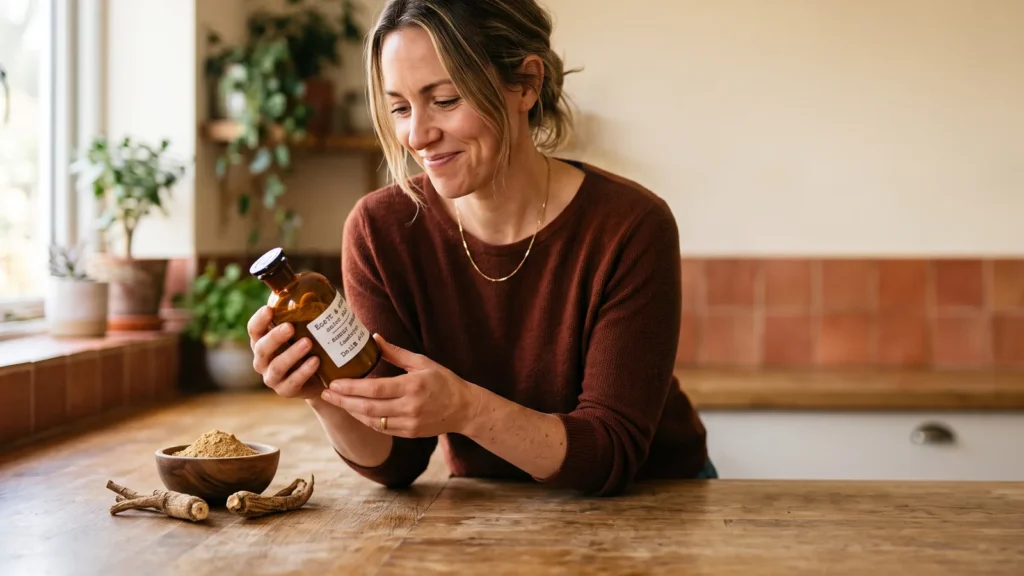
The evidence for stress is real but much narrower than the marketing suggests, and the bottle you buy is probably not the one that was studied. Meanwhile Denmark has banned ashwagandha outright and France has recommended against it for several groups — while in the US it sits on gas station shelves next to the gum.
That gap between “banned in one country, unregulated snack in another” is the most useful thing to understand about this plant, and almost nobody writing about it mentions it.
Here is what the trials actually found, why the products are not interchangeable, and the four groups of people who should not take it.
What the research actually found
This is one of the better-studied herbal supplements, which is not the same as being well studied.
A 2021 systematic review pulled together seven trials covering 491 adults, comparing ashwagandha against placebo over six to eight weeks. It found meaningful reductions in stress and anxiety on validated rating scales, along with lower cortisol. Doses ranged widely — 240 to 1,250 mg a day of extract — and the benefit appeared stronger at 500 to 600 mg than at lower doses.
For sleep, a 2021 meta-analysis of five trials covering 372 adults found what it described as a small but significant improvement. The effect was clearer at 600 mg a day, at treatments lasting at least eight weeks, and in people who actually had insomnia rather than people sleeping normally.
In 2022 an international taskforce from the World Federation of Societies of Biological Psychiatry and the Canadian Network for Mood and Anxiety Treatments went as far as a provisional recommendation of 300–600 mg a day of root extract for generalised anxiety disorder — while explicitly saying they could not make a stronger one without more data.
So: a genuine signal, in small short trials, mostly for stress. That is more than most of the supplement aisle can claim, and considerably less than the packaging implies.
One limitation worth stating plainly, because it affects how much the results transfer: the great majority of these trials were conducted in India, several of them on proprietary extracts by researchers connected to the companies selling them. That does not make the findings wrong. It does mean the evidence base is narrower than seven trials and 491 people already sounds.
The part that should change how you shop
Here is the practical problem nobody puts on a label. The trials did not test “ashwagandha.” They tested specific, separately manufactured extracts:
| Extract used in trials | What it was |
|---|---|
| KSM-66 | Root only, standardized to over 5% withanolides |
| Sensoril | Root and leaf |
| Shoden | Root and leaf, 21 mg withanolide glycosides per 60 mg capsule |
| NooGandha | Root and leaf, tested at 225 and 400 mg |
| Prolanza | Sustained release, 15 mg withanolides per 300 mg |
| Witholytin | Root, 1.5% withanolides — and it did not reduce perceived stress |
Root and leaf are chemically different. Standardisation percentages differ several-fold. And in the trial of Witholytin, the extract reduced fatigue but failed to reduce stress at all — a reminder that these are not one product wearing different names.
So “ashwagandha works” is not really a meaningful sentence. If you are buying based on a study you read about, the only way to get what was tested is to check which extract the study used and buy that one, at that dose. Most bottles do not tell you the withanolide percentage at all.
Why Denmark banned it
In 2020 the Technical University of Denmark published a risk assessment covering ashwagandha’s possible effects on thyroid and sex hormones, and its possible effect on pregnancy. Denmark banned it in 2023.
In 2024 the French agency ANSES issued a statement recommending against ashwagandha for pregnant and breastfeeding women and for people with endocrine disorders.
The US has taken no comparable action, and it remains freely available as a dietary supplement. Which regulator is right is genuinely unsettled. What matters for you is that this is not a fringe safety worry invented by sceptics — two European food safety bodies looked at the same evidence Americans are looking at and reached a much more cautious conclusion.
The liver signal
There is a small but real pattern of liver injury.
One case series describes five people, three men and two women aged 21 to 62, who took supplements containing 450 to 1,350 mg of ashwagandha daily for periods ranging from one week to four months, and developed signs of liver injury — jaundice, itching, nausea, lethargy, abdominal discomfort. Additional cases have been reported since, some in people who already had liver disease.
The reassuring part: in these cases people improved after stopping. The honest caveat: several of the products involved were combination supplements and their contents were never independently verified, so it is not always certain the ashwagandha was the culprit.
Signs to stop and call a doctor: yellowing of the skin or eyes, dark urine, persistent nausea, unusual itching, or unexplained fatigue.
The thyroid question
Ashwagandha appears to nudge thyroid hormones. In a trial of 50 people with subclinical hypothyroidism, 300 mg twice daily for eight weeks lowered TSH and raised T3 and T4 compared with placebo. Three case reports describe thyrotoxicosis in women taking it, all resolving when they stopped.
If you take thyroid medication, this is a conversation with your doctor rather than a decision to make in a supplement aisle. Not because the risk is large, but because the interaction is plausible and easily monitored.
On pregnancy, the story is more tangled than either side admits
You will read that ashwagandha causes miscarriage. The claim traces largely to a monograph published in 2000 by the American Herbal Pharmacopoeia.
In 2024 the American Herbal Pharmacopoeia issued a press release stating that their report had been misrepresented, and that there is no evidence ashwagandha root causes abortions.
So the widely repeated claim is weaker than it sounds — and the sensible conclusion is still the cautious one. Nobody has run a trial in pregnancy and nobody is going to. In the absence of evidence either way, and with two European agencies advising against it, this is not the thing to experiment with while pregnant or breastfeeding.
Who should not take it
- Anyone pregnant or breastfeeding. See above. Absence of evidence, not evidence of safety.
- Anyone with a thyroid condition or on thyroid medication.
- Men with hormone-sensitive prostate cancer — ashwagandha may raise testosterone.
- Anyone with existing liver disease.
- Anyone on medication for diabetes, blood pressure, immune suppression, or sedatives — interactions have been reported with all four.
And a general one: safety has only been demonstrated for around three months of use. What happens over years is simply unknown, which is worth sitting with given that most people take it as an indefinite daily habit.
So should you take it?
If you are a healthy adult with ordinary stress, not pregnant, not on the medication list above, and you want to try it: the evidence says the reasonable version is 300–600 mg a day of a root extract standardized to about 5% withanolides, for eight weeks, and then an honest assessment of whether anything changed.
Buy a product that states its withanolide percentage. If it does not, you have no idea what you have bought. The same problem turns up with turmeric, where a cup of golden milk contains a fraction of a research dose.
And treat three months as a checkpoint rather than a milestone — the safety data stops there, so your own use should at least pause there.
If your stress is severe enough that you are searching for something to take, that is worth a conversation with a doctor regardless of what the bottle promises. Not because ashwagandha is dangerous, but because a supplement with a small effect in short trials is a thin answer to a large problem.
Sources: NIH Office of Dietary Supplements and the 2024 ANSES opinion.