
Does a Hot Bath Actually Help You Sleep?
Yes, but only if you get out 60 to 120 minutes before bed. The mechanism is cooling, not warming, which is why the timing is the whole thing.
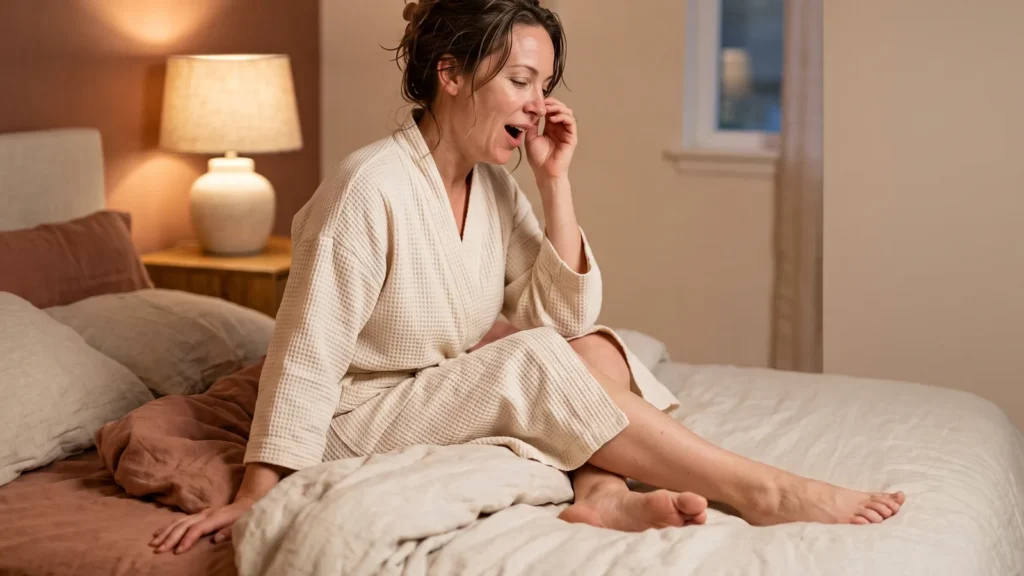
Yes — but only if you get out of it 60 to 120 minutes before you want to be asleep. A bath taken ten minutes before bed does close to nothing, and may make falling asleep slightly harder.
That timing is not a detail. It is the entire mechanism, and it is the part almost every “relaxing bedtime routine” article leaves out.
Here is what the research found, why the warmth is not what helps, and the shortest version that still works.
What the research found
A 2019 systematic review and meta-analysis pooled 13 trials of what researchers call water-based passive body heating — a warm bath or shower before bed.
The findings were unusually specific for sleep research:
| Variable | What worked |
|---|---|
| Water temperature | 104–109°F (40–42.5°C) — warm, not scalding |
| Timing | 1 to 2 hours before bed, with around 90 minutes looking best |
| Duration | As little as 10 minutes |
| Effect on time taken to fall asleep | Shortened by roughly 36% |
A third off the time spent lying awake, from ten minutes in warm water, is a better return than most things sold for sleep.
Why it works — and it is not relaxation
This is the part that changes how you use it.
To fall asleep, your core body temperature has to drop. That fall is one of the signals your body reads as the beginning of sleep. It happens on its own in the evening; the bath simply makes it happen faster and more sharply.
The route is slightly counter-intuitive. Warm water pulls blood toward the surface, particularly to your palms and the soles of your feet, which are unusually good at shedding heat. Once you get out, all that blood near the skin dumps warmth into the room — and your core temperature falls further and faster than it otherwise would.
So the bath is not warming you into sleepiness. It is a way of cooling you down more efficiently. The warmth is the setup; the drop afterwards is the effect.
Which explains the timing. That drop takes an hour or more to play out. Get into bed while you are still warm and you have had the setup without the payoff — you are, briefly, hotter than you were before, which is the opposite of what falling asleep needs.
The practical version
- Aim to get out about 90 minutes before you want to be asleep. For an 11pm bedtime, that is a 9:20 bath.
- Warm, not hot. 104–109°F. Comfortable to sit in, not the temperature that turns your skin pink.
- Ten minutes is enough. Longer is fine, not necessary.
- A shower works too. The trials included both.
- Do not undo it. Heavy blankets, thick pyjamas or a warm bedroom afterwards work against the same drop you just engineered. A cool room helps.
And a note for anyone who has read that a foot bath is a shortcut: warming the feet is genuinely part of the mechanism, since the soles are one of the main places heat leaves the body. It is a reasonable substitute when a full bath is not practical.
When it will not help
Sleep problems have causes, and thermoregulation is only one of them. This will not do much if what is keeping you awake is a racing mind, pain, a newborn, a snoring partner, or a genuinely uncomfortable bedroom.
It also treats sleep onset — how long it takes to drop off. If your problem is waking at 3am and staying awake, this is a different problem and a bath is not its answer.
If you have trouble sleeping most nights for more than a few weeks, or you are exhausted during the day despite sleeping, that is worth raising with a doctor rather than solving in the bathroom. Persistent insomnia responds well to treatment, and the effective treatment is usually not a product.
The version worth remembering
Warm bath, ten minutes, ninety minutes before bed, cool room afterwards.
It is one of the few pieces of sleep advice with real numbers behind it, and the numbers say the clock matters more than the candles.
Source: the 2019 meta-analysis in Sleep Medicine Reviews.