
How High to Hang a Picture (and Why 57 Inches Isn’t Eye Level)
Center of the picture at 57 inches — but the nail goes higher, and the eye-level claim everyone repeats does not match the CDC numbers.
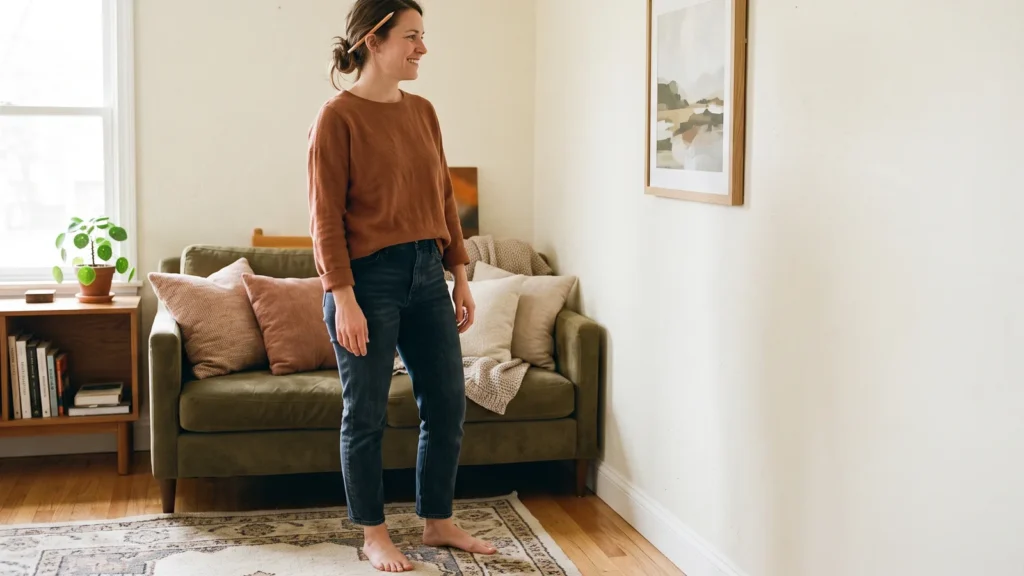
Put the center of the picture 57 inches from the floor. Not the top of the frame, not the nail — the middle of the picture itself. That one distinction is why most pictures end up too high.
You will also read that 57 inches is average eye level. It is not, at least not in America, and the real reason the rule works is more useful than the reason usually given.
Here is the number, the arithmetic that trips people up, and the five situations where 57 is the wrong answer.
The arithmetic everyone gets wrong
The 57 inches refers to the center of the artwork. But you do not hang artwork by its center — you hang it by a hook, and the hook sits higher than the center by an amount that depends on your frame.
If you measure 57 inches up the wall and put the nail there, the picture will hang low. If you measure to the top of the frame instead, it will hang high. Both are extremely common.
The formula that actually works:
Hook height = 57 + (height of the picture ÷ 2) − (drop from the top of the frame to the taut wire)
That last number is the one people forget. Lift the wire on the back of the frame until it is taut, as it will be when hanging, then measure from that point up to the top edge of the frame. On most wired frames it is somewhere between one and four inches. On a frame with a sawtooth hanger it is close to zero.
A worked example. A picture 24 inches tall, with the taut wire sitting 3 inches below the top edge:
- 57 + 12 = 69
- 69 − 3 = 66 inches — that is where the nail goes
Nine inches higher than the number you started with. That gap is the single most common reason a picture looks wrong on a wall.
About that “average eye level” claim
Almost every article repeating the 57-inch rule explains it as average human eye level. The arithmetic does not support that for a US audience.
According to CDC measured data, the average American adult is 68.9 inches tall for men and 63.5 inches for women. Eye level sits roughly four to five inches below the top of the head. That puts actual eye level around 64 inches for men and 59 for women — an adult average somewhere near 61 or 62 inches.
So 57 inches is not average eye level. It is about five inches below it.
That is not a reason to abandon the rule. It is a reason to understand what the rule is actually for.
Why it works anyway
Three reasons, and none of them is the one usually given.
- Consistency beats optimisation. A gallery hangs everything to one center line so a room reads as deliberate. The exact number matters far less than every piece sharing it.
- Looking slightly down is more comfortable than looking up. A center a little below eye level is easier on the neck than one a little above.
- At home, you are usually sitting. On a sofa, your eye level is closer to 40–45 inches. Against that, 57 is already generous.
Which is the real insight: the museum standard assumes a standing viewer in a room built for standing. Your living room is not that room.
The five times 57 is the wrong answer
| Situation | What to do instead |
|---|---|
| Above a sofa or headboard | Ignore 57 entirely. Hang the bottom of the frame 6–8 inches above the furniture back. Any more and the picture floats away from the furniture; any less and it looks crowded. |
| Above a console, sideboard or fireplace | Same principle, 5–10 inches above the surface depending on what is standing on it. |
| Rooms you only ever sit in | Drop to around 52–54 inches. Reading nooks, dining rooms, TV rooms. |
| Ceilings above 9 feet | 57 can look marooned. Raise it a few inches, or hang a taller arrangement rather than a higher one. |
| Stairways | Follow the stair angle. Measure 57 inches from each individual tread nose, not from the floor below. |
For a gallery wall, the 57 inches applies to the whole arrangement, not to any one frame. Treat the group as a single rectangle, find its center, put that at 57.
A quick reference
| Picture height | Nail height, wire 2 in. slack | Nail height, sawtooth hanger |
|---|---|---|
| 12 in. | 61 in. | 63 in. |
| 16 in. | 63 in. | 65 in. |
| 20 in. | 65 in. | 67 in. |
| 24 in. | 67 in. | 69 in. |
| 30 in. | 70 in. | 72 in. |
| 36 in. | 73 in. | 75 in. |
These assume a bare wall, nothing beneath. Over furniture, use the 6–8 inch rule instead.
The two-minute method
- Hold the frame against the wall and lift the wire taut with one finger, exactly as the hook will hold it. Note where your finger sits relative to the top edge.
- Measure the picture’s height, halve it, add 57, subtract that wire drop.
- Mark the wall with a pencil at the resulting height.
- Check it with a level before committing, especially for two hooks.
- Stand back and sit down before you decide. If the room is one you mostly sit in, trust the seated view.
If you get it wrong, a nail hole in drywall takes about thirty seconds and a fingertip of spackle to fix. The cost of experimenting is much lower than the cost of living with it.
The thing worth remembering
One number, honestly held: center at 57 inches, six to eight above furniture. Everything else here is arithmetic in service of those two.
And if a picture already hangs somewhere you like, leave it. The rule exists to make a room feel considered, not to overrule a room that already does.
Height figures: CDC National Center for Health Statistics. The 57-inch line is a gallery convention, not a research finding.
Height is one of three things that decide whether a living room reads as considered. The other two are the size of the rug and where the curtains stop.