
Oil Pulling: What Dentists Say It Can and Cannot Do
No reliable evidence for whitening or cavities, and the ADA says so plainly. Weak evidence for gums, one real risk nobody mentions, and what it cannot replace.

Not for the two things it is usually sold for. There is no reliable evidence that swishing oil whitens teeth or reduces cavities, and the American Dental Association says so in plain language. The evidence for gum inflammation is a little better but still weak, and none of it is a reason to brush less.
Which is a shame, because oil pulling is one of the few wellness trends with a genuinely long history behind it rather than a marketing department. It is worth understanding what it can and cannot do, including one risk that almost no article mentions.
What it is, and where it comes from
Oil pulling means holding a tablespoon of edible oil — sesame traditionally, though coconut has taken over online — in the mouth and swishing it between the teeth, anywhere from a few minutes to twenty. It is a traditional practice from India and southern Asia, long predating any of the claims now attached to it, where it belongs to a broader oral-care routine rather than standing alone as a cure for things.
That distinction matters. Most of what has gone wrong in how oil pulling is sold in the US comes from lifting one step out of a routine and selling it as a replacement for the whole routine.
Claim by claim, what the evidence shows
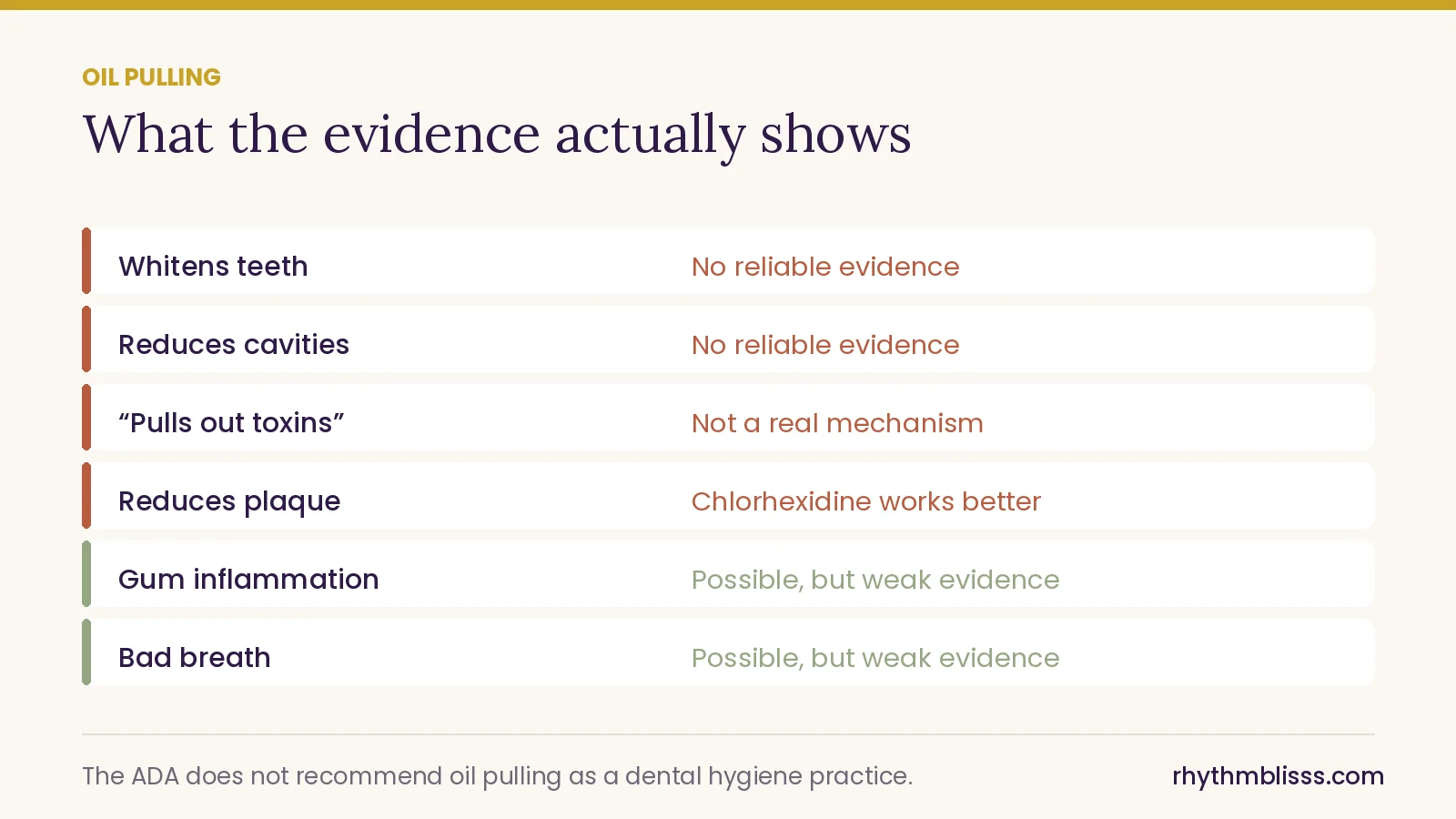
| The claim | What the evidence says |
|---|---|
| Whitens teeth | No reliable evidence. The ADA states there are no reliable scientific studies showing oil pulling whitens teeth. |
| Reduces cavities | No reliable evidence. Same ADA position. |
| “Pulls toxins out” | No. This is not a mechanism that exists. Oil does not draw anything through the lining of your mouth. |
| Improves gum inflammation | Possibly, weakly. Reviews have found a probable benefit for gingival health — but the studies are small, mostly at high or unclear risk of bias, and reviewers rate the certainty as low to very low. |
| Reduces plaque | Worse than the alternatives. A 2024 review in the International Journal of Dental Hygiene, pooling 25 randomized trials, found chlorhexidine mouthwash significantly more effective, and rated the evidence for oil pulling on plaque as very low quality. |
| Freshens breath | Some limited evidence, on the same weak footing as the gum findings. |
The honest summary is that the one area with any signal — gum inflammation — is also the area where the studies are weakest, and where a cheap thing you already do (flossing) has far better evidence behind it.
The ADA position, in full
It is short enough to quote rather than paraphrase:
Based on the lack of scientific evidence, the American Dental Association does not recommend oil pulling as a dental hygiene practice.
Their standing advice remains brushing twice a day for two minutes with fluoride toothpaste, flossing once a day, and not using tobacco. Nothing in the oil pulling literature displaces any part of that.
There is also a mechanical reason it cannot substitute for brushing. Dental plaque is a biofilm that physically adheres to the tooth. Once it has formed, swishing does not disrupt it in the way a brush does. Oil is not an abrasive and it is not a solvent for biofilm.
The risk almost nobody mentions
Oil pulling is generally low-risk, but it is not zero-risk, and the one real hazard is rarely mentioned in the articles recommending it.
If oil is inhaled rather than swallowed or spat, it can cause exogenous lipoid pneumonia — inflammation in the lungs from the oil itself. There are published case reports of this following repeated sesame oil pulling. It is rare, and most healthy adults will never have a problem. But the risk is meaningfully higher for anyone who has trouble swallowing, and researchers reporting these cases have said explicitly that people at risk of aspiration should be told about it before taking up the practice.
In practice this means oil pulling is a poor idea for young children, for older adults with any swallowing difficulty, and for anyone with a condition affecting swallowing or cough reflex. If you get a coughing fit while doing it, stop.
The practical things nobody tells you
- Never spit it in the sink. Coconut oil is solid below about 76°F. It will set in your drain and build up. Spit it into the trash.
- Never swallow it. Whatever you swished around is exactly what you were trying to get rid of, and a tablespoon of oil on an empty stomach is a reliable route to nausea and loose stools. If a child is doing this, supervise it.
- Twenty minutes is folklore, not a finding. Study durations vary widely and nothing establishes twenty as the number. If your jaw aches, you are doing it too hard — it should be gentle.
- Do it before brushing, not instead of it.
- Sesame is the traditional oil. Coconut is the one that went viral. Neither has been shown better than the other in any convincing way.
So should you bother?
If you enjoy it and it has become part of a morning you like, there is no strong reason to stop — provided you are not in one of the higher-risk groups above and it is not replacing anything.
But if you took it up because you read it would whiten your teeth or fix cavities, it will not, and the ten minutes would do more for your mouth spent flossing. That is a less satisfying answer than the internet gives, and it happens to be the true one. The same gap between claim and evidence shows up in what is actually in a cup of turmeric milk.
If your gums bleed when you brush, that is worth a dentist rather than an oil. Bleeding gums are common and treatable, and they are also the thing oil pulling gets recommended for most often by people who have not looked at what the evidence actually says.
Sources: the American Dental Association and a 2024 review in the International Journal of Dental Hygiene.