
Six Ways to Make a Room Feel Warmer Tonight
Change the bulbs, not the cushions. Six things you can do tonight with what is already in the house, starting with the number on the bulb box.
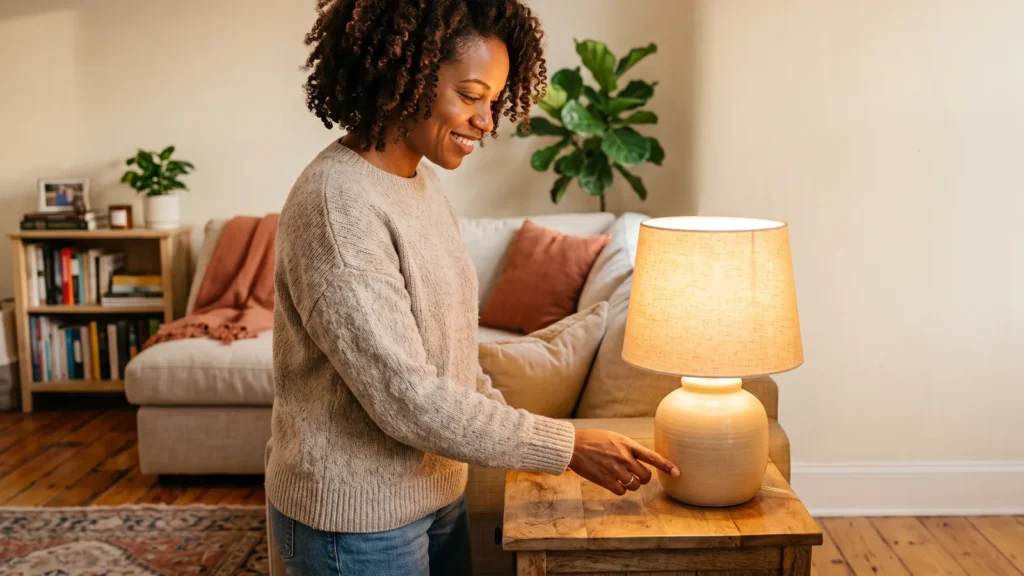
Change the bulbs. Not the cushions, not the paint — the bulbs. A room that feels cold almost always has the wrong colour temperature in it, and swapping that is the single cheapest change with the biggest return in the whole of home decorating.
Everything else here costs nothing at all. These are six things you can do tonight, with what is already in the house, and the room will look different by the time you sit down.
1. Check the number on the bulb box
Light has a temperature, measured in Kelvin, and it is printed on every box. This is the number that decides whether a room feels like a living room or a waiting room.
| Kelvin | What it looks like | Where it belongs |
|---|---|---|
| 2700K | Warm, golden, like a lamp at dusk | Living rooms, bedrooms, dining rooms |
| 3000K | Soft white, slightly crisper | Kitchens, bathrooms |
| 4000K | Cool white, noticeably blue | Garages, laundry rooms |
| 5000K+ | Daylight. Clinical | Workshops. Not homes |
If a room has always felt faintly unwelcoming and you have never known why, walk over and look at a bulb. There is a good chance it says 4000K or higher, because that is what gets sold as “bright.”
Warm light is genuinely the whole trick. A 2700K bulb makes wood look richer, skin look better and cream walls look soft rather than grey. It is a few dollars and it changes a room more than a new rug.
2. Turn the big light off
One light source in the ceiling flattens everything beneath it. It puts shadows under people’s eyes, it makes a room read as a box, and it is why a space can feel less inviting at 8pm than it did at 4pm.
The fix costs nothing: use the lamps you already own and leave the overhead off. Three small pools of light at different heights will always beat one big one from above.
If you have only one lamp, move it off the side table and onto the floor beside a chair. Light coming from lower down is instantly softer.
3. Pull the furniture off the walls
Most people push every piece of furniture flat against the wall, which makes a room feel like a waiting area with a hole in the middle.
Move the sofa forward even four inches. Angle a chair slightly toward it rather than square to the wall. The room will feel smaller in the best way — gathered rather than spread out.
4. Give every seat something to put a cup on
This is the most reliable comfort test in a room, and it costs nothing to check. Sit in each seat in turn. Can you put down a drink without standing up?
If the answer is no, that seat is subtly uncomfortable to sit in and nobody will be able to say why. A stool, a stack of books, a tray on an ottoman — anything within reach will do.
5. Add one thing that is alive
A plant, a branch from the garden in a jug, herbs on the windowsill. Rooms with something growing in them read as tended.
And it genuinely does not need to be a good plant. A single stem of eucalyptus in a glass on a kitchen table does more for how a room feels than most things you could buy for it.
6. Turn one light on before dark
Not after. Before.
Switching a lamp on at four in the afternoon, while there is still light outside, is the difference between a room that gets darker around you and a room that becomes warm as the evening arrives. It is a two-second habit and it is the one people notice most when they visit.
If you do only one
Change the bulbs to 2700K and turn the overhead light off.
That is a few dollars and one habit, and it will do more than a season of shopping. Most rooms are not badly furnished — they are just badly lit, and lighting is the part nobody thinks to look at.
The rest of it — the rug that is the right size, the curtains that reach the floor, the pictures at the right height — those matter too. But they matter far less than whether the light in the room is kind.
Light is doing more work in a room than most people realise, and the same is true of how high the pictures are hung.